
Review · speech-to-text bench, part 2 — measured Nov 8, 2026
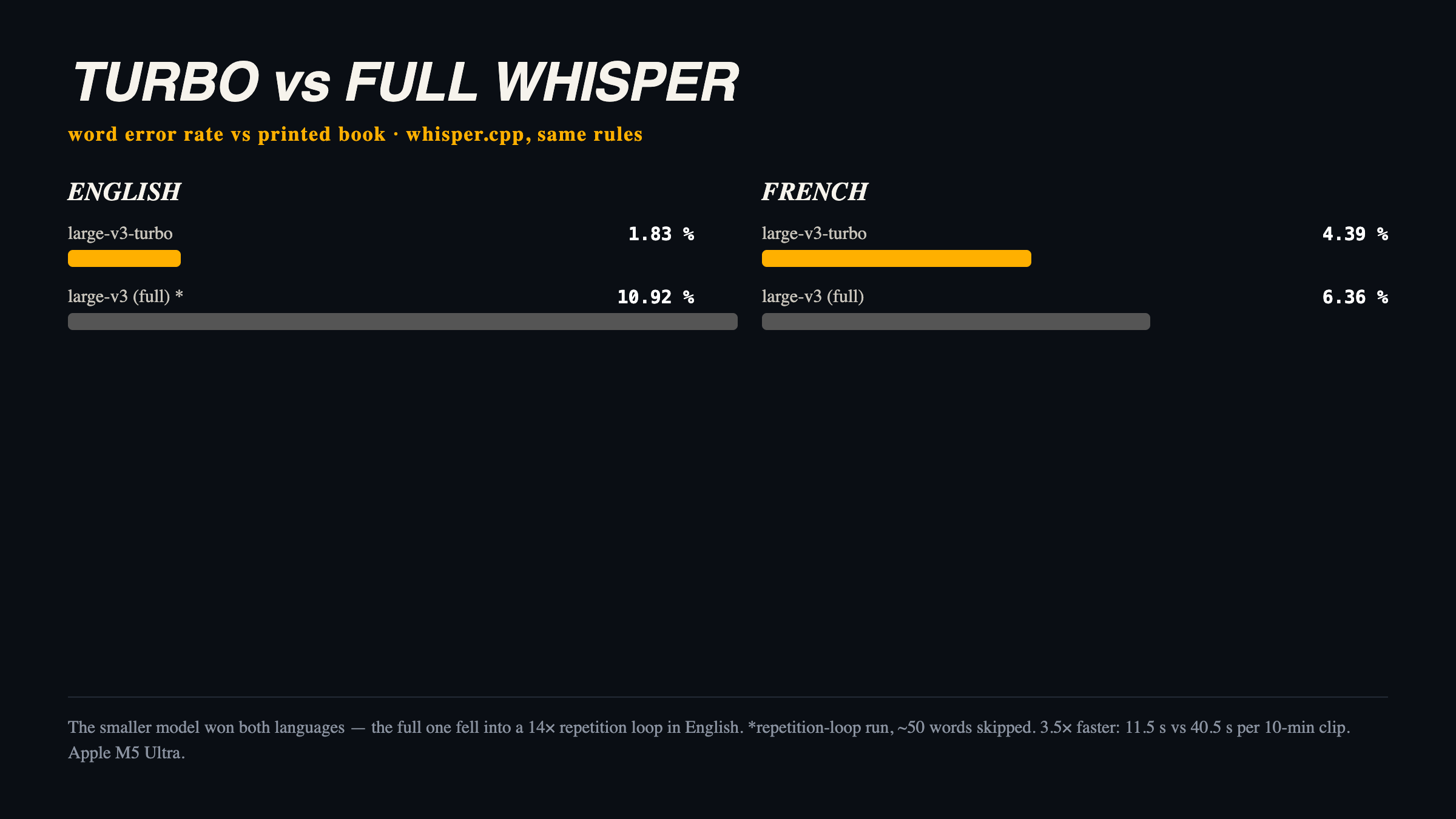
Run transcription locally with whisper.cpp + large-v3-turbo: in our bench the 8×-smaller turbo model beat the full large-v3 on accuracy and was 3–4× faster, for €0 and zero internet.
The conventional wisdom says the small model is the compromise: you trade accuracy for speed. We tested that trade on our transcription bench — same audio, same scoring method as our Nemotron-vs-Whisper review, two ggml models in whisper.cpp — and the trade didn’t show up. The full model lost both races.
Model A: whisper.cpp + ggml-large-v3-turbo (0.8 B params, 1.6 GB pack) Model B: whisper.cpp + ggml-large-v3 (1.6 B params, 3.1 GB pack) Hardware: Apple M5 Ultra, Metal backend, same machine back-to-back Audio: ~10-min Alice in Wonderland chapter (EN) · ~6-min Jules Verne chapter (FR) Scoring: word-by-word Levenshtein against the printed book
The numbers
| Model | English WER | French WER | Time EN clip | Time FR clip |
|---|---|---|---|---|
| large-v3-turbo | 1.83 % | 4.39 % | 11.5 s | 7.5 s |
| large-v3 (full) | 10.92 % | 6.36 % | 40.5 s | 24.4 s |
Same machine, same runtime, same decoder settings. The smaller, 3.5× faster model transcribed both languages with fewer errors. Case closed? Not quite — and the asterisk matters.
What the 10.92 % actually is: a captured repetition loop
Word Error Rate punishes hallucinated words twice: they count as insertions, and they bury the real text. That is exactly what happened. Eleven minutes into Alice, the full model stopped following the reading and started spinning:
“…because she thought it was a bad thing to do, and she thought it was a good thing to do, and she thought it was a bad thing to do…” — that clause cycle ran 14 times, verbatim.
Our diff caught 239 edit operations against the printed text, most of them generated by that loop; by the end of the chapter the model had recovered and finished cleanly (“…very soon finished off the cake”). So the honest reading of this bench is not “large-v3 is 6× worse than turbo”. It is:
- large-v3 has a real, documented-in-practice repetition failure mode, and on a 10-minute clip the failure cost us a 6× WER penalty with no warning in the output.
- large-v3-turbo did not hit a single loop in either language — 40 and 49 total edits, all plausibly real misrecognitions.
- Even excluding the loop, the full model was worse in French too (6.36 % vs 4.39 %) with no failure mode to blame. On audiobook-style speech, this is a genuine loss.
When large-v3 still earns its 3 GB
We are not claiming large-v3 is obsolete. It carries non-turbo features the turbo pack dropped — translation from other languages, and the full multilingual training that helps on noisy, accented or specialist audio. Our clips were clean studio readings. If your corpus is messy meeting recordings, the round-2 noisy-audio bench we have planned is precisely the test that could reverse this ranking; we will update this table, not quietly edit it.
Practical takeaways
- Default to turbo. 11.5 seconds for a 10-minute chapter (~52× real time) with the best accuracy we measured locally. That is not a compromise, it is the current sweet spot.
- Validate length, not just text. The loop added ~50 words of junk; a silent omission in another runtime dropped ~70 (our next post). Two cheap sanity checks catch both: word count vs expected, and repeated-phrase detection. Two lines of script, worth it in any pipeline.
- Benchmark on your own audio. Every number in the industry press is somebody else’s corpus. Two chapters and a Saturday afternoon is enough to know which model wins on yours.
Method, exactly
Whisper.cpp (Homebrew, Metal backend) with the official ggml quantization packs, default 5-second-beam decoding, fp16 on Apple silicon. Ground truth from Project Gutenberg and Wikisource; punctuation and case stripped, Unicode normalised, then global Levenshtein alignment; WER = (substitutions + insertions + deletions) / reference words. Raw transcripts, reference texts, and the scoring script are in our repo; the /benchmarks/ page links the versioned results.
For local transcription today: whisper.cpp + large-v3-turbo. It won on speed, on English accuracy, and on French accuracy — and it never lost the plot. The full model keeps its place only where its extra features are needed.