
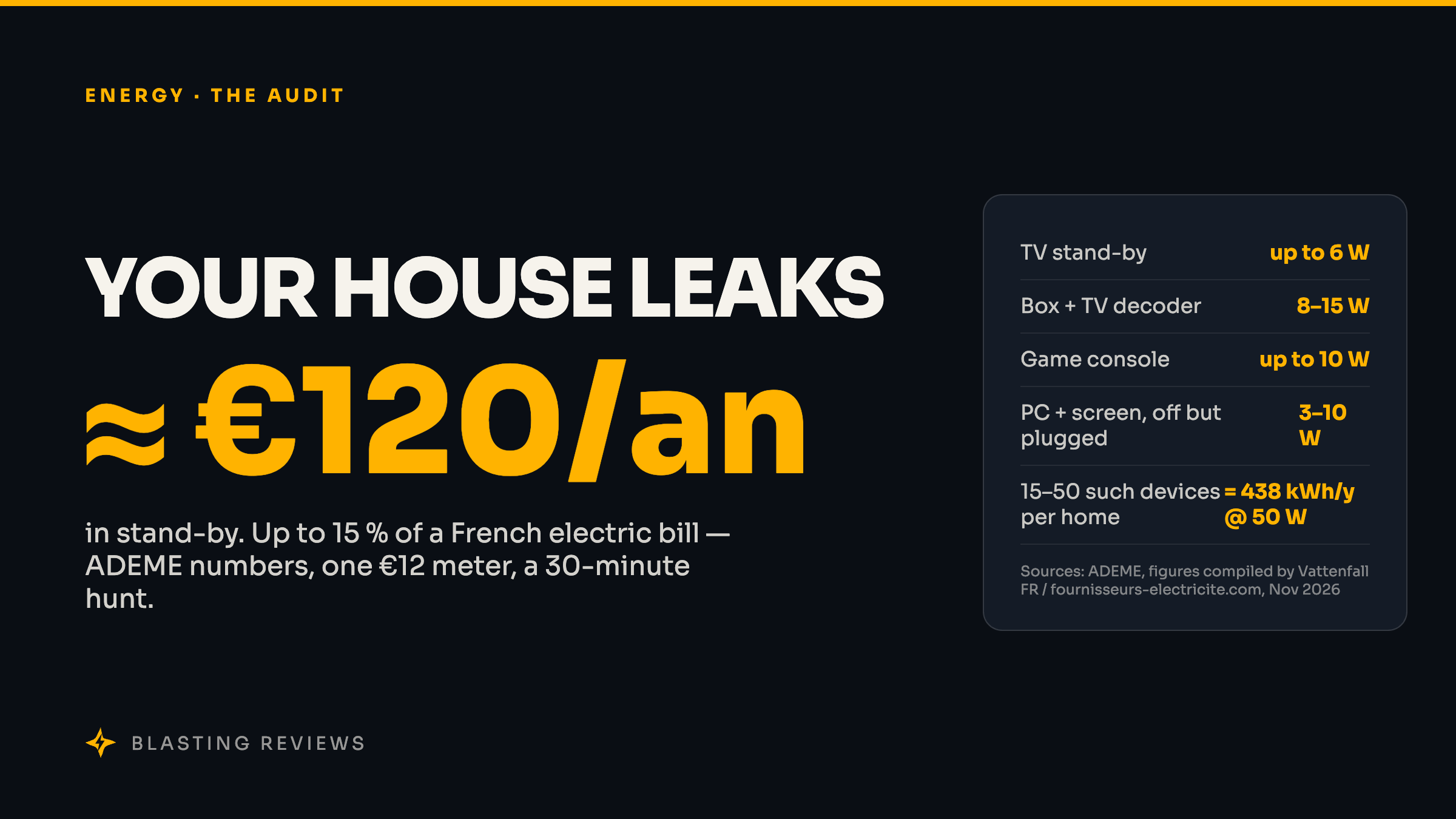
Energy · The Audit
Up to 10–15 % of a French electricity bill (heating excluded) evaporates into stand-by — call it €100–130 a year. A €12 plug meter finds it in one evening; a couple of switched power strips close the leak. Do this before any sexier purchase on this site.
Stand by, in the words of everyone who should know and no one who acts: the electricity of being off. ADEME has been quantifying it for years — 15 to 50 devices per French home still drawing current while nominally switched off, worth 10–15 % of the bill outside heating and hot water, roughly €100–130 a year in a typical apartment at the regulated tariff. The math is embarrassingly simple: a combined 50 W of little red LEDs running 24/7 is 438 kWh a year, about €88 at the November 2026 regulated rate.
The hit list, with watts
The devices actually worth your evening, per ADEME’s figures as compiled by Vattenfall France:
| TV stand-by | up to 6 W — a 2026 TV is a computer; some don’t have an off button at all |
| Internet box + TV decoder | 8–15 W, 24/7 — the champion: a decoder’s “off” is a lie |
| Game console | up to 10 W in instant-on/rest mode |
| Desktop PC + screen | 3–10 W off-but-plugged; sleep modes far more — ADEME says 75 % of a PC’s lifetime electricity is spent doing nothing |
| Hi-fi, speakers with standby LEDs, anything with a clock or a “fast wake” | 2–10 W each |
Multiply by your device count — “my setup is modest” usually means “twenty of these”. That five-port thing under your TV with a router, a decoder, a soundbar and two chargers idling is not background noise. It’s €50–90 a year of amber LEDs.
The 30-minute hunt
Two ways, both cheap. One: a €10–15 plug-in wattmeter (the same form factor as the smart plug in our first review — the Tapo P110 does this job and keeps reporting forever). Walk the house: box first, then TV corner, then PC desk, then consoles. Write down every number above 1.5 W while everything is “off”. Two if you have a Linky-linked sensor (Ecojoko or similar): watch the house baseline after everyone goes to bed — a true night floor for an apartment is under ~100 W, and anything 40+ W above it is a leak with an address. If you own a P110 already, put it on the TV corner and the desk and let it log a week — this is exactly the data the meter exists for.
Closing the leak, without a rewire
Switched / smart power strips on the TV corner and the PC desk — the entire class of small offenders dies with one switch each; a €20 strip pays back in a winter. Decoder: don’t rage-quit your ISP — many boxes have a genuine eco mode deep in settings that cuts the TV-output standby; check the model thread before cutting the fiber’s power (re-provisioning pain is real). Consoles: turn off “instant-on”/rest mode; you lose 15-second wake and save several kWh a month. Chargers and clocks: genuinely small; do them last, don’t buy a €60 “eco” kit for them. What we explicitly do not recommend: daily unplugging rituals. A switched strip is a habit you actually keep; rituals die by 20 December.
Do the audit this week. Every euro-per-month it finds funds this site’s real test gear — and unlike any smart speaker review, the payback is measurable by you, on your own meter, before winter breaks.
Method note: ADEME figures (standby 10–15 % of the non-heating bill, 15–50 devices/home, per-device watts, the 75 % PC claim) as published by ADEME and compiled by Vattenfall FR and fournisseurs-electricite.com (Nov 2026, regulated tariff); € conversions use ~€0.20/kWh regulated rate at writing time and will drift. No own-instrument measurements are claimed for individual devices — that’s what your wattmeter is for. Corrections, with sources, to the contact page.