
Smart home · Opinion — prices in this article are dated screenshots, not live offers; see our disclosure
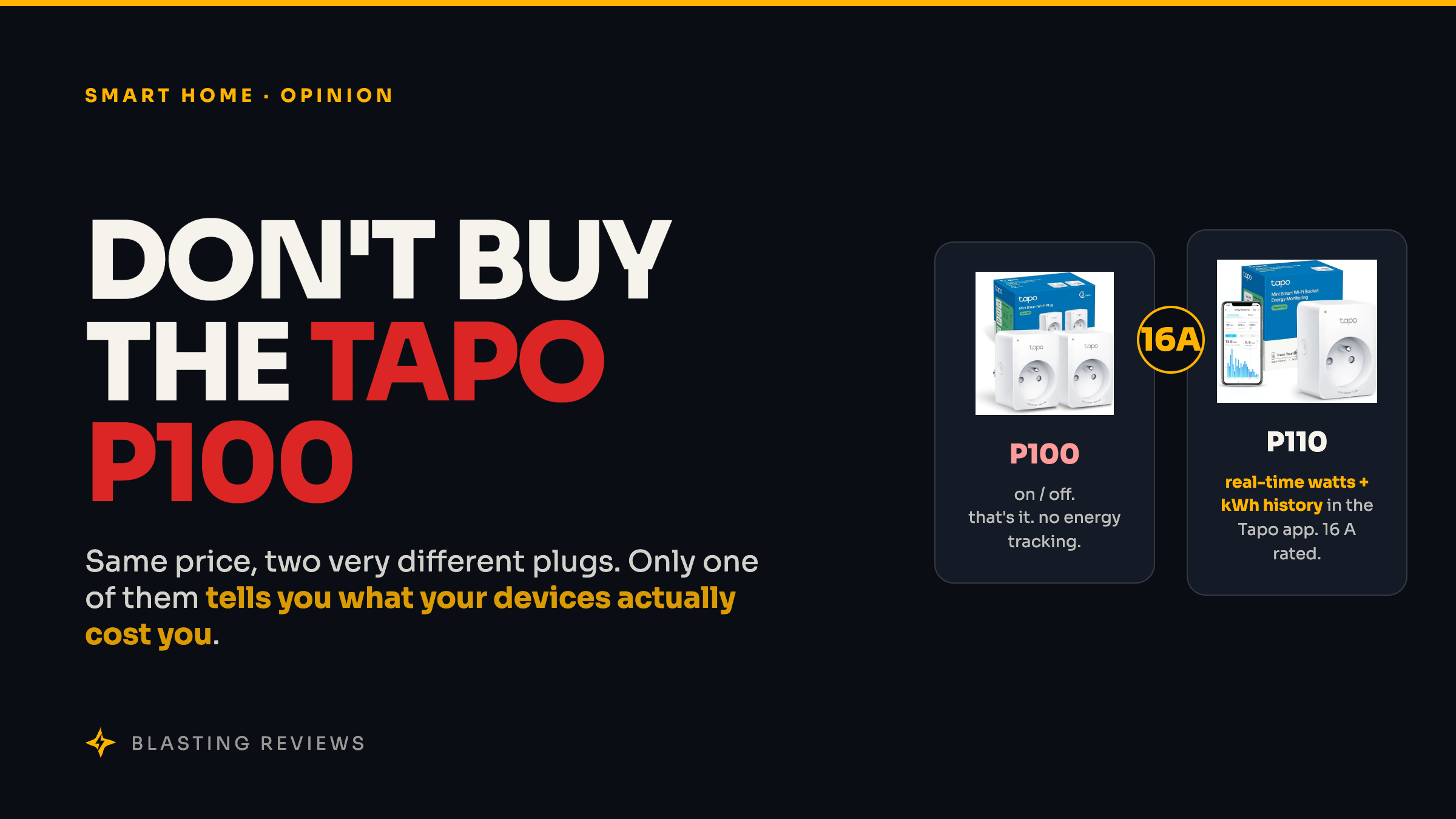
The P100 works fine as a remote on/off switch. But at the same €11.99 right now, the P110 tells you what your appliances actually cost you — the one smart-plug feature you’ll still be using in year three. Buying the P100 today means paying full price for half a product.
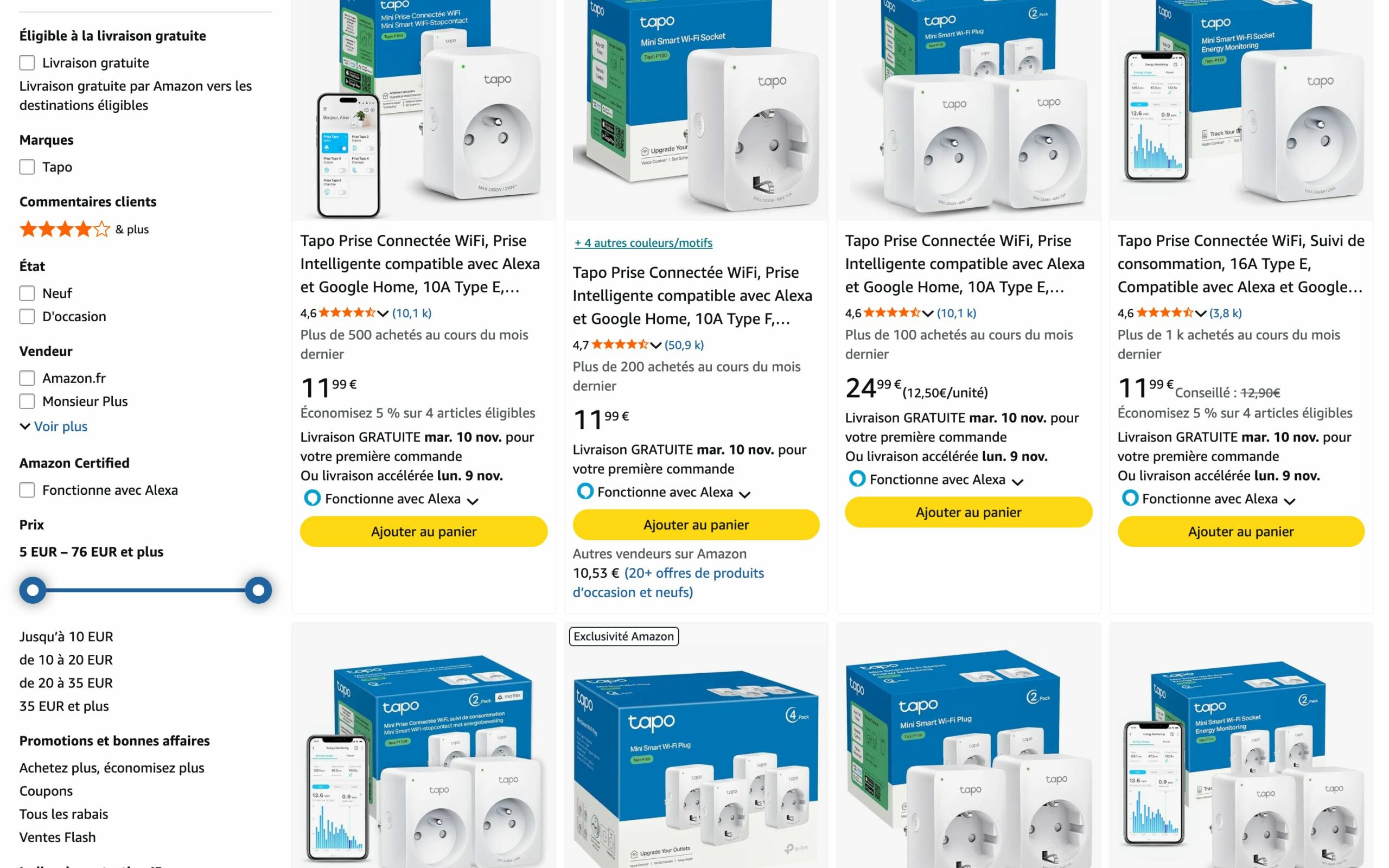
Open Amazon.fr today and search “tapo p100”. The first result is the P100 at €11.99. Do the same for “tapo p110”: same number, €11.99, same day, both sold and shipped by TP-Link’s own store in Type E (the French earth-pin format). Two plugs, identical price, and TP-Link’s own support FAQ draws the line in one sentence: “The Tapo P110 and P115 support energy monitoring; the P100 and P105 do not.”
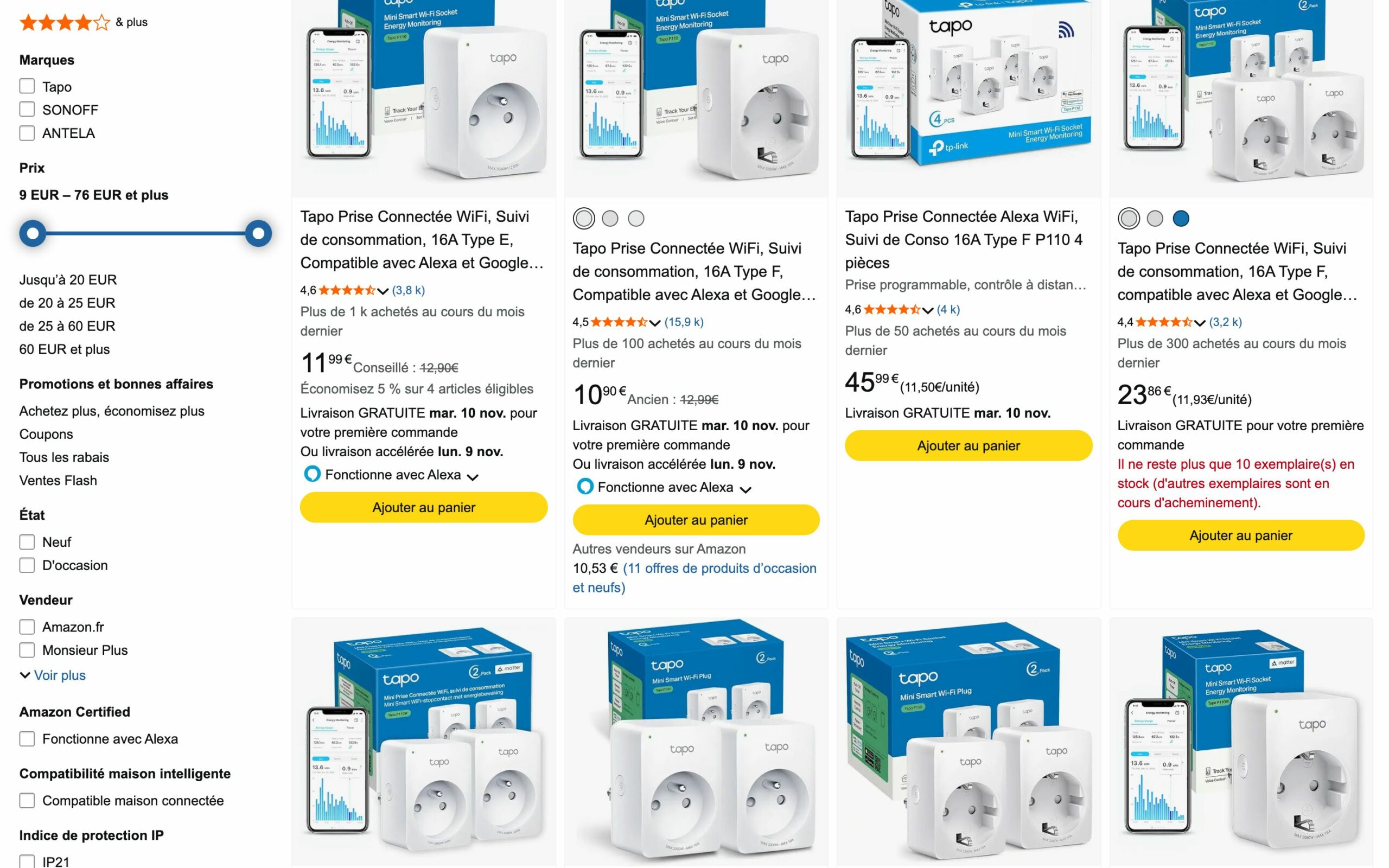
So when the price gap disappears, the P100 stops being “the cheap option” and becomes the bad option. This isn’t a feature you’ll never touch: it’s the entire reason a smart plug is worth more than the €12 it costs.
The difference, stated by the manufacturer
Both plugs do the obvious stuff identically: on/off from the Tapo app, schedules, away mode, Alexa and Google Home. The P110 adds a meter. In the app it turns into real-time power (watts), today’s and this month’s energy (kWh), and per-plug history. The P100 knows nothing about what flows through it; it’s a relay with Wi-Fi.
Gough Lui, who tore both units down in June 2026 for what is still the most careful English-language treatment of them, describes the P100 plainly: “just an ordinary smart plug without any energy monitoring capabilities”, sold cheaper — historically. That “historically” is doing the work: French prices have collapsed onto each other.
Why watts are the whole point
Because the expensive thing in your home isn’t the plug, it’s what you plug into it. A failing fridge compressor, a pool pump stuck on long cycle, a ten-year-old freezer eating 2 kWh a day: these fail silently. Electricity doesn’t fail loudly, it just bills. At the regulated French rate (roughly €0.25/kWh), that 2 kWh-a-day freezer costs you around €180 a year — and a plug that measures it pays for itself in three weeks. You can’t find that problem with a P100, because a P100 can’t see it.
It’s also the only cheap way to actually check whether your Time-of-Use contract (Tempo, auto, dynamic API offers) is doing anything for the devices you switch on the cheapest hours. Without a meter, that’s faith, not data.
The spec sheet nobody reads
| Energy monitoring | no — TP-Link confirms it | yes — live watts, kWh, monthly history |
| Rated load | 10 A (≈2 300 W) | 16 A (≈3 680 W) |
| Form factor | compact | compact (same footprint) |
| Matter support | no | no (that’s the P110M, €27.69) |
| Amazon.fr price, checked 7 Nov 2026 | 11,99 € | 11,99 € (Type E) |
The 16 A rating is not trivia either: a P110 can legally carry a full 3.68 kW circuit (heater, power tool, EV-trickle tricks). The P100 tops out around 2.3 kW, and a heater that draws 2.5 kW on a P100 is a plug that will die young — or worse.
Fine, when DO you buy the P100?
Two cases, honestly:
- You don’t want to know. Four lamps on schedules, a Christmas tree, a fountain. The P100 in 4-packs (~€25 → €6.25 a socket) is the best dumb-switch money in Europe, and measuring a 9 W LED is theatre.
- You already meter at the panel. If your house runs on Shelly EM / 3PM clamps or a Linky sensor with per-circuit dashboards, the plug level may add noise, not insight.
That’s it. Everything else — one-off purchases, “just the one for the coffee machine” — is a €11.99 decision, and at the same price, buy the one that measures.
What other reviewers say
The comparison threads land the same way. Reddit’s Tapo community put it bluntly in its plug-comparison thread: the P110 “adds energy monitoring, same as P100 but with real-time power consumption tracking — the price difference over P100 is small.” (That was written when the difference was small; today it’s zero.) Ireland’s ConnectIT, reviewing the pair, reached the same conclusion: “the main difference is that the P110 has an energy monitoring feature that the P100 does not.” Nobody, anywhere, has ever argued the P100 is the smarter buy at equal cost.
One thing to watch at checkout
Buy Type E for France (round earth pin), and buy from the TP-Link official storefront or a Prime seller you trust — marketplace listings occasionally ship P100 boxes to people who ordered P110s at the last price shock. The model number is printed on the face of the plug; check it before you bin the box.
We’re putting both plugs on a reference wattmeter this week — the accuracy story is where the P110’s real numbers come from, and we’ll publish the error curve against a calibrated meter, not vibes.
Prices checked on Amazon.fr on 7 November 2026 and will drift. No affiliate links yet on this site — when they appear, they’ll be marked. Product images are TP-Link press material; our own photos follow after Wednesday’s measurement session.