

Smart Home · Analysis
The HomeView is real hardware and it looks genuinely good — but as of its 13 November launch you cannot buy it in the EU at all (Apple’s own words: “not available for sale in the European Union”), and no grey-import workaround gives you the one feature it exists for: Siri AI. EU HomeKit households: stay on HomePod mini + an iPad you already own.
Apple announced the HomeView on 13 October 2026 and opens sales on 13 November — in the US, UK, Canada, Australia, New Zealand, India and Singapore. Not France. Not Belgium. Apple’s press release says the quiet part out loud: the device is “not available for sale in the European Union, as Siri AI is currently unavailable in iOS in the EU”. Same Siri, same DMA fight, same European wallets told to wait. So let’s do what Apple won’t: an honest look at what EU users are being locked out of — and whether the thing is even worth the €-equivalent of $299.
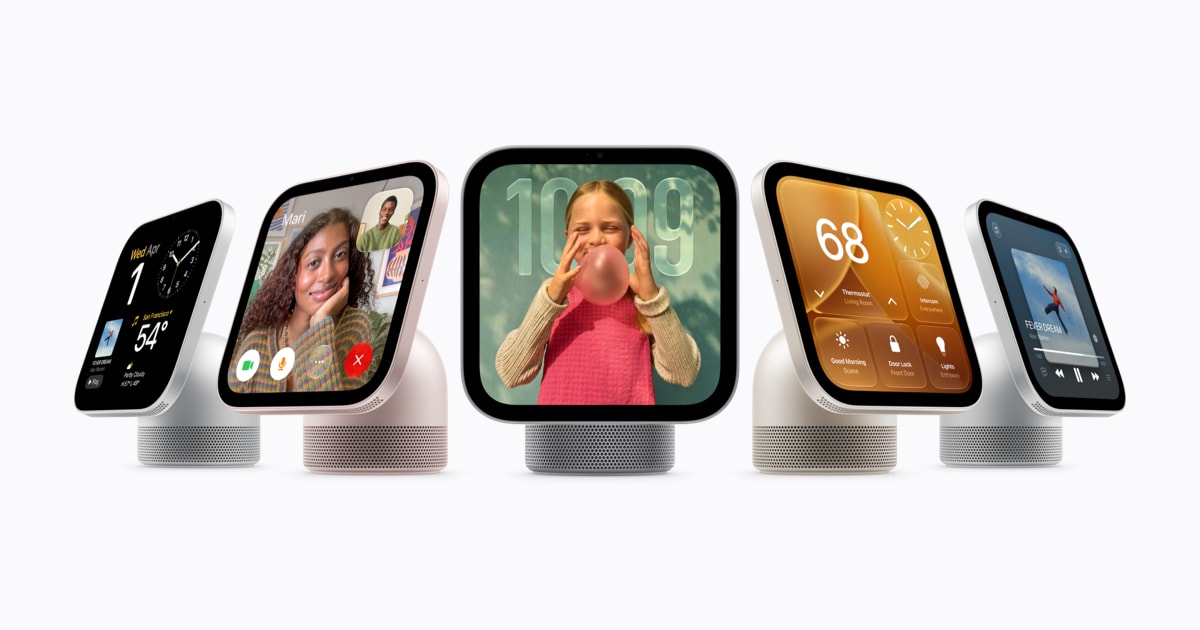
What it is, by the numbers
Strip the keynote and it’s this: a 7-inch square Liquid Retina display (0.3–500 nits, True Tone) on an aluminium hinge, A18 chip inside, a 12 MP Center Stage camera, and a speaker system Apple clearly spent real engineering on — two full-range drivers in the display, a down-firing woofer and force-cancelling radiators in the base. Wall-mounted and tabletop versions, same $299. It recognises up to six faces and swaps the whole interface per person — messages, calendar, reminders, private per user. It streams up to nine HomeKit camera feeds at once, and with iCloud+ you get the end-to-end-encrypted person/package/pet detection bolted onto the display. That is the best smart-home dashboard Apple has ever shipped, and the nine-feed camera wall is genuinely the feature I’d use every day.
The catch is structural, and WIRED got it immediately: it does not run iOS or iPadOS. There is no App Store. Third-party apps arrive through a curated, CarPlay-derived framework — Spotify-class audio apps, nothing video-streaming. Netflix and YouTube only exist here if those companies choose to port, which they have every reason not to do. So the honest category isn’t “iPad for the kitchen”. It’s “HomePod with a face” — a voice-first room hub that happens to show you things.
What the EU is actually missing
Everything interesting on the spec sheet runs through Siri AI — the new conversational Siri that Apple still can’t ship in the EU because iOS itself can’t get its user-facing AI past the DMA’s gatekeeping rules. Take Siri AI away and a HomeView in Paris would be a $299 smart display that answers with the old, dumber assistant. Apple could theoretically ship an EU variant; the sensible reading of its own press release is that it won’t, because half the product walks out with the AI. This is the second generation of Apple hardware that French buyers can read about and not buy — after the same ritual with earlier Apple Intelligence features. The cost of the delay isn’t abstract: it’s the reason EU smart-home content gets reviewed last, priced in dollars, and supported in English.
What to do while Apple sorts out Brussels
For HomeKit households in France, the honest stack today: HomePod mini + an old iPad on a stand gets you 80 % of the HomeView experience — Siri, camera feeds in the Home app, per-room audio — for €99 and a drawer you already own. For a wall-mounted control panel, an Android tablet driving Home Assistant remains the power-user answer; it is clunkier, uglier and infinitely more capable. If you travel or have family in the US, do NOT grey-import a HomeView “for later”: the Siri-AI-dependent features are region-tied to the account and iOS version, and you would be buying a very pretty €280 photo frame.
Wait, EU. The hardware deserves a real test — “Expert Reviews” in the UK already measured the plate of claims and liked it — but there is no version of this you can buy and use as designed from France today. When Apple finds its “path forward” with the EU, as its release promises, we’ll have a bench and our own hands on it.
Method note: this is a launch analysis, not a hands-on review — no unit is purchasable in the EU, so nothing here was measured by us. Facts attributed: Apple Newsroom (13 Oct 2026 press release and product store), Ars Technica, CNBC, WIRED, MacRumors roundup, all accessed 7 November 2026. Spec claims are Apple’s. When we get a unit through legit means, this page gets a measured update with its own date.